 MrGripper
The short answer
To test grip strength at home, sit upright with your upper arm at your side and elbow bent to 90°, then squeeze a hand dynamometer maximally for three seconds. Do three trials per hand, resting 60 seconds between them, and record each hand separately. Without a dynamometer, use a max dead hang, a rated gripper close, or a timed pinch hold.
That's the method. The part most home testers get wrong isn't the squeeze — it's everything around it. A grip number only means something next to another number taken under identical conditions, which is why the protocol below is worth more than the device you buy.
And there's one number almost every home test throws away: the gap between your hands. More on why that's the most useful thing you'll measure.
How do you test grip strength with a dynamometer?
A hand dynamometer is the tool clinicians and researchers use, and basic models are inexpensive. The standardized clinical position — the one behind most published grip data — works just as well on your kitchen chair.
- Sit upright, back supported, feet flat, with your back, pelvis, and knees each at roughly 90°.
- Tuck your upper arm against your side, shoulder neutral (not rotated out), elbow bent to 90°, forearm neutral so your thumb points up.
- Keep the wrist straight — the standard position allows up to about 15° of ulnar deviation, nothing more.
- Set the handle and leave it there. On an adjustable dynamometer, position 2 suits most adults; whatever you pick becomes permanent.
- Squeeze maximally for about 3 seconds. Build to full effort fast. No jerking, no swinging the arm, no leaning into it.
- Rest 60 seconds, then repeat. Three trials per hand.
- Record each hand separately, and average the three trials.
Two details in that list carry more weight than they look.
Handle position isn't a comfort setting. In a study of 50 adults tested at five handle positions, position 2 produced each person's best score 70% of the time, and averaged just 0.8 kg below their individual best position — which is why it's recommended as the single standard setting (Trampisch et al., J Hand Surg Am, 2012). Practical translation: pick position 2, write it down, never change it. Changing the handle between tests invents progress that isn't there.
Average, don't cherry-pick. The clinical convention is the mean of three trials, because averaging smooths out the bad rep and the lucky one (Shirley Ryan AbilityLab, RehabMeasures). Strength sports usually record the best of three instead. Both are defensible. Mixing them is not — a "best" compared against last month's "average" is a fake PR. Choose one convention and keep it for life.
The protocol at a glance
| Variable | Standard | Why it matters |
|---|---|---|
| Posture | Seated; back, pelvis, knees ≈ 90° | Leaning or standing recruits the body, not the hand |
| Shoulder | Adducted, neutral rotation | An abducted arm changes the force line |
| Elbow | Flexed 90° | The single biggest postural influence on the reading |
| Forearm / wrist | Neutral, thumb up; wrist straight (≤ ~15° ulnar deviation) | Wrist angle changes what the finger flexors can produce |
| Handle | Position 2, locked for good | 0.8 kg from most people's best position — consistency beats optimization |
| Effort | ~3 s maximal | Long enough to peak, short enough to avoid fatigue |
| Trials | 3 per hand, 60 s rest | Grip fatigues fast and recovers slowly |
| Score | Mean of 3 (or best of 3 — pick one) | Mixing conventions fabricates progress |
Why posture rules matter: grip readings move measurably with elbow angle, wrist position, and body lean. A "PR" caused by testing standing with a locked elbow isn't progress — it's a different test.
How do you test grip strength without a dynamometer?
You can't get kilograms without a device that measures force. You can absolutely still measure whether you're getting stronger — which, for most people training grip, is the actual question. Proxy tests trade the absolute number for a repeatable one.
| Proxy test | What it measures | What it misses | Standardize |
|---|---|---|---|
| Max dead hang | Support-grip endurance | Peak crush force; thumb | Same bar, same grip width, shoes off or on — always the same |
| Rated gripper close | Peak crush strength | Endurance; support grip | Same gripper set, same hand position, no body english |
| Timed pinch hold | Thumb and pinch strength | Crush and support grip | Same plate weight, same finger position |
Max dead hang
Hang from a pull-up bar with both hands, shoulders engaged, and time it. When your hands open, the test ends. Brutally honest, zero special equipment. For a per-hand version, use assisted one-arm hangs. Full protocol in our dead hang guide.
Rated gripper close
Torsion grippers ship with resistance ratings (46 lb, 76 lb, and up). The heaviest gripper you can close — handles touching, no body english — is a repeatable maximal-strength test. Test each hand. If you train grippers anyway, this doubles as your benchmark; see the gripper routine guide.
Timed pinch hold
Pinch a smooth weight plate (or two thin plates pressed together) between your thumb and fingers and time it. This isolates thumb strength, which bar hangs and grippers barely touch.
One rule: these aren't interchangeable. A longer dead hang is endurance progress. A harder gripper close is strength progress. Track them as separate lines, never as one "grip score."
Why the gap between your hands is the number to watch
Here's the finding that should change how you test. The old clinical shorthand — the "10% rule" — says your dominant hand is about 10% stronger. Across 310 people it holds up on average, at 10.74%. But split by handedness, it falls apart: right-handers averaged a 12.72% difference, while left-handers averaged −0.08% — essentially no difference at all (Petersen et al., Am J Occup Ther, 1989).
So if you're left-handed, your hands should be roughly equal, and a 10% gap isn't "normal dominance" — it's a real asymmetry worth training. If you're right-handed, a gap in the low teens is unremarkable, but a gap that grows over months is a signal.
Either way, the useful metric isn't a rule of thumb. It's your own gap, measured the same way, tracked over time. That's the number a single blended reading destroys — and it's exactly the number most home tests never record, because people test their strong hand and stop.
One caveat that matters for how you read your own result: a 10% gap on a single test sits inside the measurement error of grip dynamometry, so one session can't confirm an imbalance. See grip strength symmetry for the prevalence data, the thresholds that actually carry a signal, and how many sessions it takes before a gap means anything.
How do you keep results comparable over time?
The biggest error in home testing isn't the equipment. It's inconsistency.
- Same test, same setup, same convention. Same chair, same bar, same gripper, same handle position, same rest intervals.
- Test fresh. Grip fatigues quickly and recovers slowly. A test after deadlifts or a climbing session will lie to you.
- Test at a consistent time of day. Muscle strength tends to drift across the day, so a morning test and an evening test aren't strictly comparable. Pick a slot and keep it.
- Both hands, always. Testing only your dominant hand throws away the symmetry signal.
- Retest every 2–4 weeks. Frequent enough to see a trend, rare enough not to eat training days — and frequent enough that normal day-to-day noise doesn't get mistaken for a decline.
Wondering what your number actually means? Compare it against published reference ranges in average grip strength by age.
Testing during rehab
Grip measurement is standard practice in hand and wrist rehabilitation because it's objective and sensitive to change. If you're returning from injury, your physiotherapist's protocol takes priority over anything here — but consistent home measurements between appointments give both of you better data.
Track each hand separately and watch the injured side close the gap on the healthy one, rather than chasing an absolute number. The symmetry percentage is the progress metric; the kilograms are just how you calculate it.
Common mistakes
- Changing position between tests — elbow angle and handle setting both change the number.
- Mixing "best of 3" with "mean of 3" — the most common way people fake a PR without noticing.
- Testing at different fatigue states or times of day — standardize both.
- Only testing the dominant hand — you lose the symmetry signal, often the most useful part.
- Testing weekly and panicking over noise — day-to-day variation is normal. Judge the monthly trend.
- Treating one proxy as another — hang time and gripper closes are different qualities. Track separately.
Tracking your grip tests in MrGripper
A test you can't compare to the last one is just a number. MrGripper has a grip-test flow built for exactly this workflow — no proprietary hardware, works with any dynamometer or proxy test you already own:
- Open the Grip Test screen and pick Left, Both, or Right.
- Enter your readings. Each hand is stored separately and the app scores your symmetry as a percentage, so the gap is visible at a glance instead of buried in your notes.
- Log proxy tests (max hangs, gripper closes, pinch holds) as exercises with reps or hold time — the built-in timer handles duration tests.
- Insights show the trend over weeks, per hand, in kg or lbs — so a retest every few weeks becomes a progress line, not a note you lose.
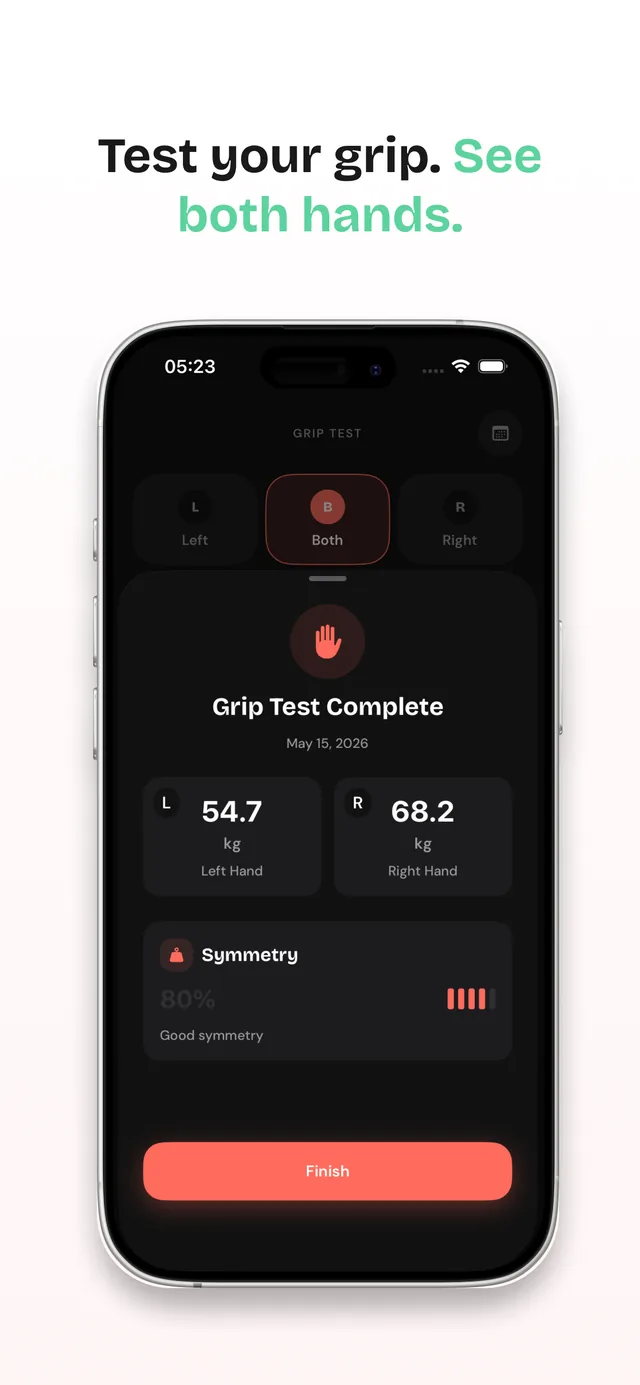
To be clear about how it works: MrGripper doesn't pair with any device over Bluetooth — you read the number off your dynamometer and enter it. That's the trade-off that lets it work with whatever gear you already own. If you'd rather not buy hardware at all, see grip tracking without a Bluetooth dynamometer.

Measure it, then beat it
Grip Strength: MrGripper is free on the App Store — grip tests, per-hand logging, and progress insights on iPhone, iPad, Mac, and Vision Pro.
FAQ
How is grip strength normally measured?
With a hand dynamometer — a device you squeeze as hard as possible that reports force in kilograms or pounds. The standard protocol is seated, upper arm at your side, elbow bent to 90°, forearm neutral, with three maximal squeezes per hand and 60 seconds of rest between trials. The score is the mean of the three.
Can I test grip strength without a dynamometer?
Yes, using proxy tests: a maximum-duration dead hang, the heaviest rated hand gripper you can fully close, or a timed pinch hold. None gives a reading in kilograms, but each one, repeated under identical conditions, tracks progress reliably. Test each hand and keep the tests as separate metrics.
How often should I retest my grip strength?
Every two to four weeks. That's frequent enough to see a trend but rare enough that test day doesn't interfere with training. Always retest fresh — never after a heavy session — at a consistent time of day, and under conditions identical to your last test.
Should I record my best attempt or the average of three?
Either works, as long as you never switch. Clinical practice averages three trials because it smooths out an unusually good or bad rep; strength sports usually record the best of three. Comparing a "best" against a previous "average" produces a personal record that isn't real.
Is it normal for one hand to be stronger?
Usually, but less predictably than the old "10% rule" suggests. Right-handers averaged a 12.72% dominant-hand advantage in one 310-person study, while left-handers averaged −0.08% — effectively none. Track your own gap over time rather than comparing it to a rule of thumb.
Which hand should I test first?
Whichever you like — just keep the order identical every time. Alternating hands between trials gives each side a longer recovery, which is why most protocols do it. What matters is that the sequence never changes between tests.
Do I need to warm up before a grip test?
A light warm-up helps, but standardize it like everything else: the same few submaximal squeezes each time, then the same rest before your first trial. An untimed, improvised warm-up is one more variable making this month's number harder to compare with last month's.
Sources
- Standardized testing position, three-trial mean, and rest interval — Shirley Ryan AbilityLab, RehabMeasures: Hand-held Dynamometer / Grip Strength.
- Handle position 2 as the standard setting — Trampisch US, Franke J, Jedamzik N, Hinrichs T. Optimal Jamar dynamometer handle position to assess maximal isometric hand grip strength in epidemiological studies. J Hand Surg Am. 2012;37(11):2368–73.
- The 10% rule by handedness — Petersen P, Petrick M, Connor H, Conklin D. Grip strength and hand dominance: challenging the 10% rule. Am J Occup Ther. 1989;43(7):444–7.