 MrGripper
What is a dead hang?
A dead hang is a bar hang from a pull-up bar: straight arms, feet off the ground, hands closed until you let go. Most people start with both hands. One-arm hangs come later.
Dead hang benefits: what hanging trains
A dead hang is a support-grip exercise. Your finger flexors work isometrically to keep your hands closed around the bar while your bodyweight tries to open them. That is the same quality that gives out when a deadlift slips, a pull-up set ends early, or a carry stops halfway.
The other benefit is time under load for the shoulders and upper back. Many people find a relaxed hang feels good after sitting. This guide stays on the grip side: hang more, and hold a little longer.
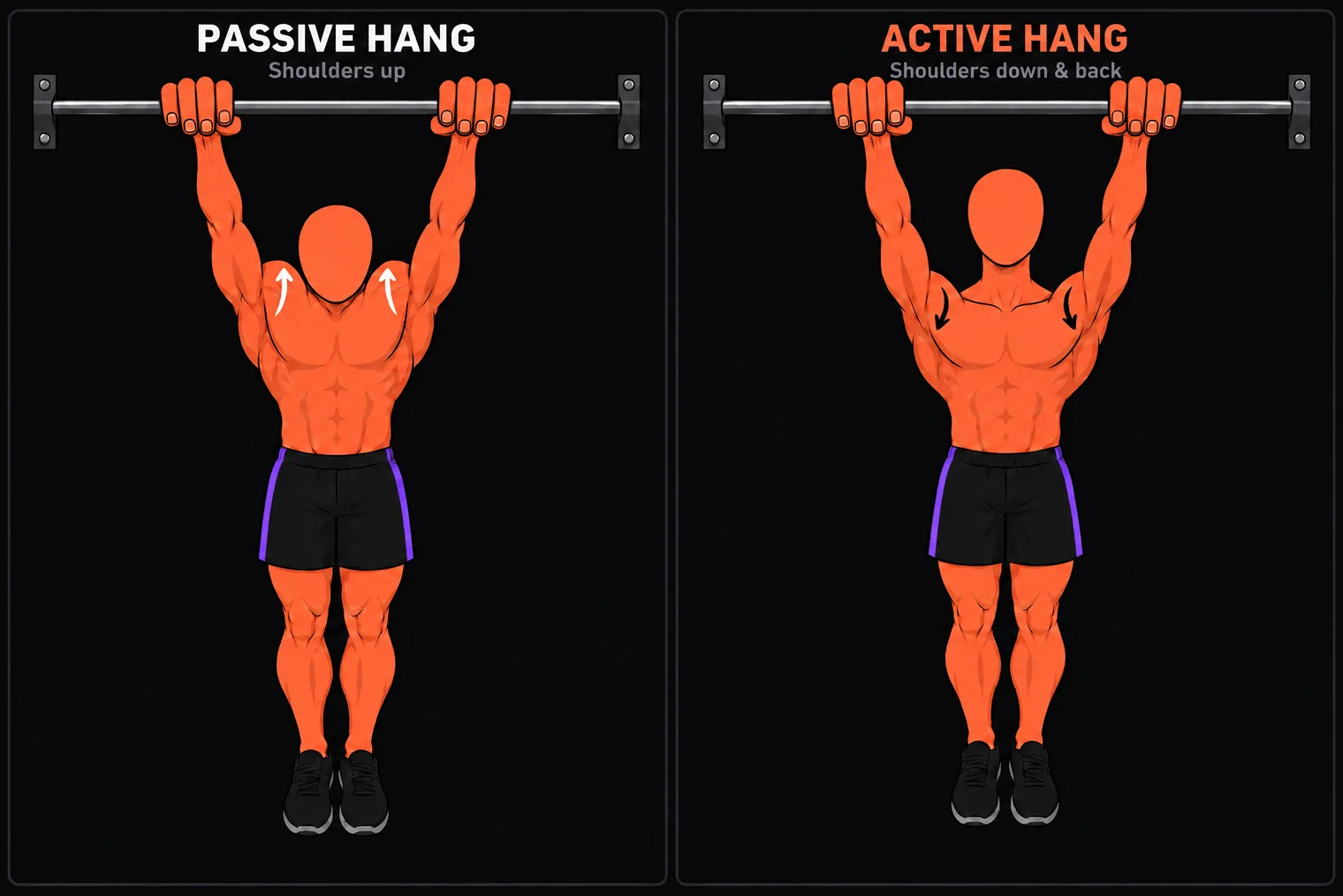
Two variations matter:
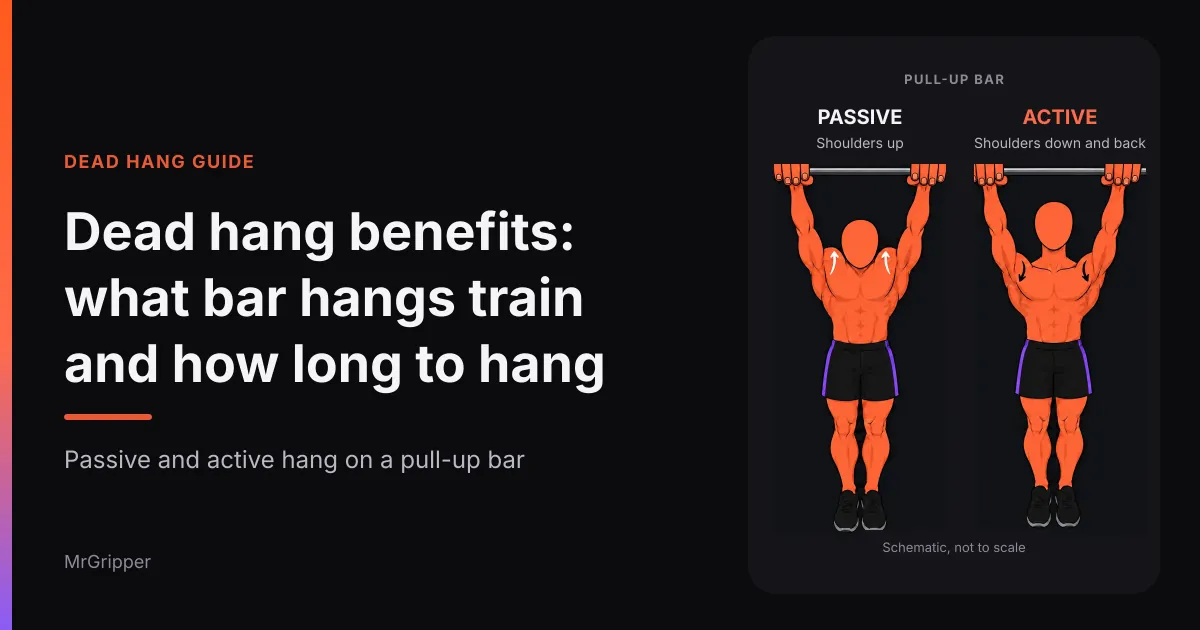
- Passive hang: arms and shoulders relaxed, shoulder blades elevated. More stretch, slightly less muscular demand.
- Active hang: shoulder blades pulled down and engaged. The position you'd start a pull-up from. Use it for most grip-focused sets.
How long should you hang?
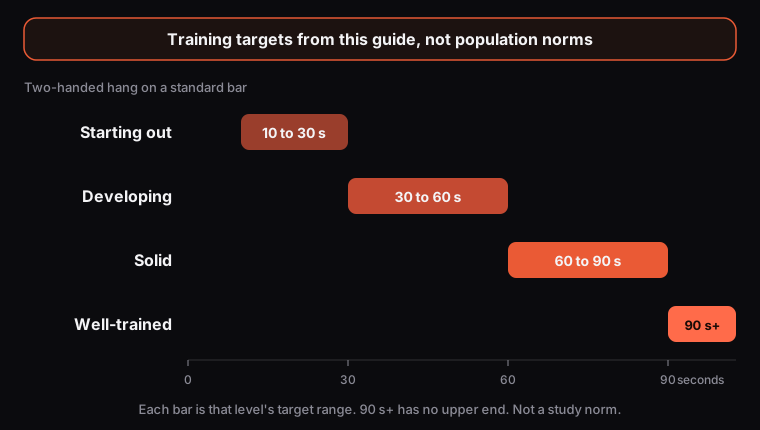
Useful working benchmarks for a two-handed hang on a standard bar:
| Level | Max hang time | What it means |
|---|---|---|
| Starting out | 10–30 s | Completely normal. Progress comes fast at this stage |
| Developing | 30–60 s | Grip is no longer the weak link for basic bar work |
| Solid | 60–90 s | A good general-fitness standard for most adults |
| Well-trained | 90 s+ | Time to add load or move toward one-arm work |
These are training targets, not medical standards. The number that matters most is your previous best.
The progression
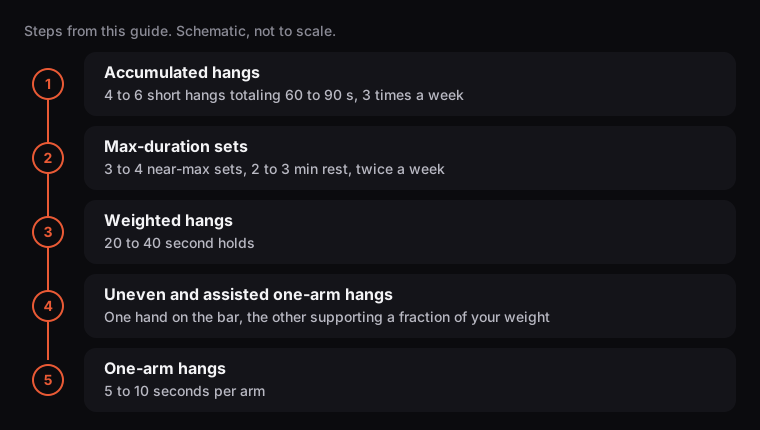
- Accumulated hangs. Can't hang 30 seconds? Do 4–6 shorter hangs (feet lightly assisting if needed) totaling 60–90 seconds, three times a week.
- Max-duration sets. Once 30+ seconds is comfortable: 3–4 sets of near-max hangs, 2–3 minutes rest, twice a week.
- Weighted hangs. Past 90 seconds, adding time builds mostly endurance. For strength, add load (dip belt, backpack) and work back down to 20–40 second holds.
- Uneven and assisted one-arm hangs. One hand on the bar, the other on a towel slung over it (or supporting a fraction of your weight). This is where hidden left–right gaps appear.
- One-arm hangs. An advanced goal in its own right; even 5–10 seconds per arm is a serious grip feat.
Grippier variations, such as towel hangs, thick-bar hangs, and fingertip edges, shift the stimulus toward crush strength and climbing-specific fingers. See the climbing grip guide before adding edge work.
One hand weaker? Make the gap visible
Two-handed hangs do not show how much each hand contributes. Assisted one-arm hangs can make the difference measurable, but the result still depends on using the same setup for both sides.
For a cleaner comparison:
- Test assisted one-arm hangs on each side and time them separately.
- Keep assistance, grip position, and trial order the same.
- Log left and right hold times as separate numbers, then repeat the comparison before interpreting the gap.
For the grip-strength research and the limits of what one result can tell you, read why one hand can test weaker.
Common mistakes
- Hanging to failure every day. Support grip responds like any strength quality: hard sessions need recovery between them. Two or three focused days a week beats daily burnout.
- Fully passive hangs for every set. Keep some shoulder engagement for most grip sets; save fully relaxed hangs for mobility work.
- Guessing your times. "About a minute" is how progress plateaus. Time every hold. The difference between 52 and 58 seconds is a training signal.
- Chasing time with degrading form. When your shoulders shrug into your ears and your breathing stops, end the set.
Timing and tracking hangs in MrGripper
MrGripper includes a built-in timer for dead hangs and static holds. You start it and you stop it. It does not measure hang force, and it does not detect when your grip lets go.
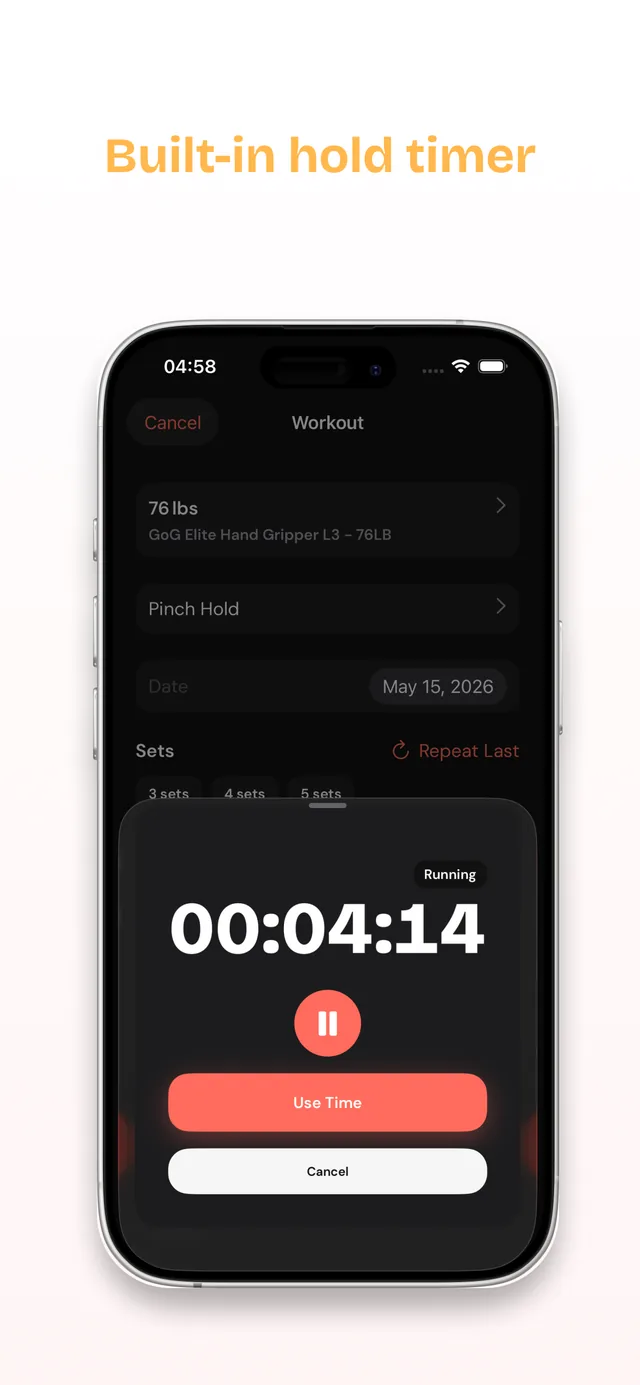
- Log hangs as timed holds. The time you stop on is the hold you log.
- Record left, right, or both hands per set, so assisted one-arm work keeps a separate history for each side.
- Insights track hold time separately from load volume, so hang progress has its own trend. Free includes 7- and 30-day trends and 30 days of history.
- Save a hang workout as a routine, with sets, hold time, and rest, and repeat it. Free includes three saved routines.
Stop guessing your hang times
Grip Strength: MrGripper is free on the App Store, with a built-in timer for dead hangs, per-hand logging, and a trend line for every hold.
FAQ
What are the benefits of dead hangs?
Dead hangs train support-grip endurance. Your forearm and finger flexors keep the bar closed under your bodyweight, and your shoulders and upper back spend time under that load. They do little for crushing or pinch strength.
How long should you be able to dead hang?
20–30 seconds is a fair starting point, 60 seconds is a solid general-fitness standard, and 90+ seconds reflects well-trained support grip. Treat them as training targets and progress against your own best.
Does dead hanging increase grip strength?
Yes, support-grip strength and endurance specifically. It won't do much for crushing or pinch strength, which need their own exercises; see the full grip guide.
Why is one hand weaker when I hang?
Two-handed hangs do not show how much each hand contributes. Compare assisted one-arm hangs with the same setup and track each side separately. A repeatable difference is a measurement pattern, not an explanation of its cause; see the full grip-asymmetry check.