 MrGripper
The short answer
The best grip-strength app that doesn't need a Bluetooth dynamometer is MrGripper — a free iPhone app that logs grip workouts and dynamometer readings from any device you already own. It tracks each hand separately, scores your left–right symmetry, and keeps PRs per exercise, equipment, load, and hand — with no proprietary hardware to buy.
One thing to be straight about first: no phone measures squeeze force on its own. If you want a number in kilograms, you need a dynamometer of some kind. The real question is whether you're forced to buy one company's specific device — or can use any dynamometer you already own, or skip it entirely and track the training instead.
Why many grip apps center their own hardware
Start shopping for a grip tracker and you often hit the same wall: the app is free, but the full experience depends on the gadget it was built for.
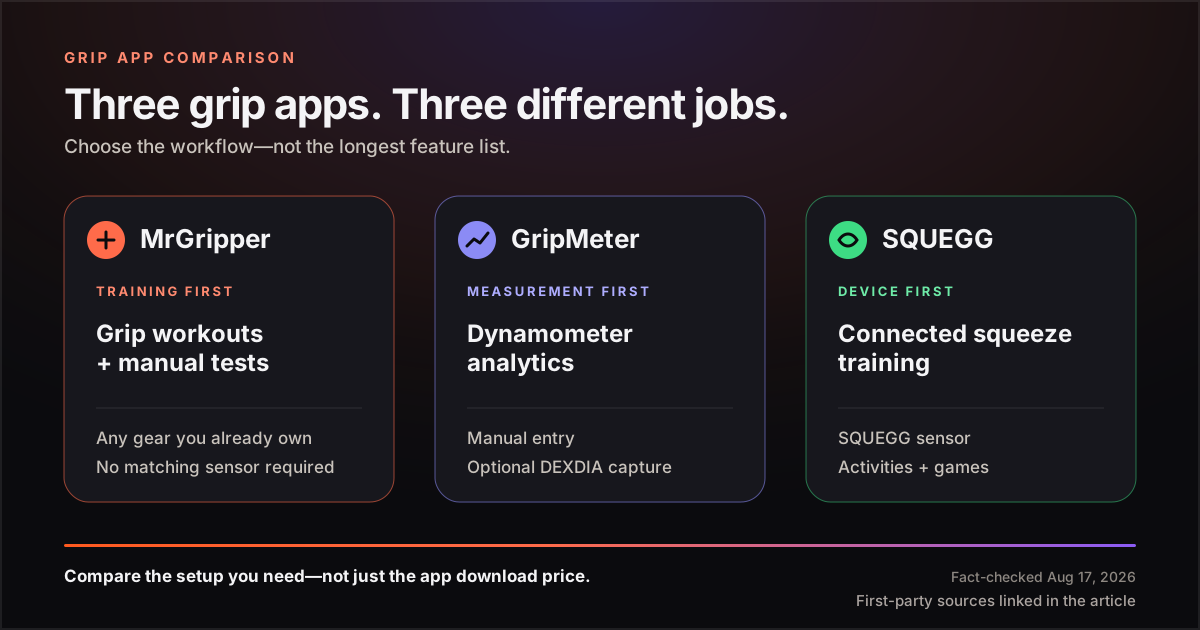
- SQUEGG is a Bluetooth squeeze ball. The app is the ball's companion — no ball, nothing to measure.
- GripMeter supports manual input from other dynamometers. A DEXDIA device adds automatic capture and richer measurement data, but it is optional.
- Tindeq's app is built around its Progressor load cell — a premium climbing tool that streams force over Bluetooth.
These are good products with different trade-offs. SQUEGG and Tindeq center their own connected devices. GripMeter can work through manual entry, with DEXDIA available when automatic capture matters.
| App | How it records force | Matching hardware required? | Device price | App cost |
|---|---|---|---|---|
| MrGripper | Manual entry from any dynamometer — or track workouts with no dynamometer at all | None — use gear you already own | $0 | Free (Pro optional: $4.99/mo, $29.99/yr) |
| SQUEGG | Its own smart squeeze ball, over Bluetooth | SQUEGG device | ~$109–129 | Free |
| GripMeter | Manual entry from another dynamometer, or automatic DEXDIA capture | No for manual entry; DEXDIA GX optional | $0 matching hardware for manual entry; reviewed DEXDIA pricing varied by region | Free |
| Tindeq | Its Progressor load cell, over Bluetooth | Progressor 200 | ~€210 (US varies) | Free |
What you actually need to track grip strength
Strip away the gadgets and grip tracking comes down to three things:
- Per-hand data. Your hands are rarely equal, and a single blended number hides it. If you only ever see one figure, you can't tell that your weaker side is quietly lagging — until an injury or a stalled lift forces the issue.
- A left–right symmetry score. The imbalance is the insight. Seeing balance as a number is what turns "my right feels stronger" into something you can actually train back to even.
- PRs and progression that match how grip works. Grip isn't one lift. It's this gripper, that hangboard, a pinch block, each hand, crush versus support versus hold. A personal record only means something when it's tracked at that level.
None of that requires a $449 clinical device. It requires consistent logging — and, if you want force numbers, any dynamometer will do. If you're new to measuring, our guide on how to test grip strength at home walks through the protocol.
How MrGripper tracks grip without any hardware
MrGripper is a free app for iPhone and iPad (and Apple Silicon Macs and Vision Pro). It gives you two honest ways to track grip, neither of which needs proprietary gear.
If you own a dynamometer — any brand. Run a grip test, read the kilograms off the device, and enter left, right, or both. To be clear: MrGripper does not pair over Bluetooth and it can't read a device for you — you type in the number. The upside is that it works with whatever you've got, from an inexpensive analog hand dynamometer to a clinical one, and it keeps every reading in one history with a symmetry score.
If you don't own one. Skip the number and track the training. Log reps, sets, and timed holds — dead hangs, pinch holds, static holds — with a built-in timer, and build PRs per exercise, equipment, load, and hand across grippers, hangboards, rings, bands, and pinch gear. A full grip program, with gear you already own.
Either way you get the part the generic gym logger never had: per-hand logging and a left–right symmetry score. Sets and grip tests are recorded per hand, so the dashboard can score balance — generic logs merge both hands into one number and hide imbalances until they hurt.
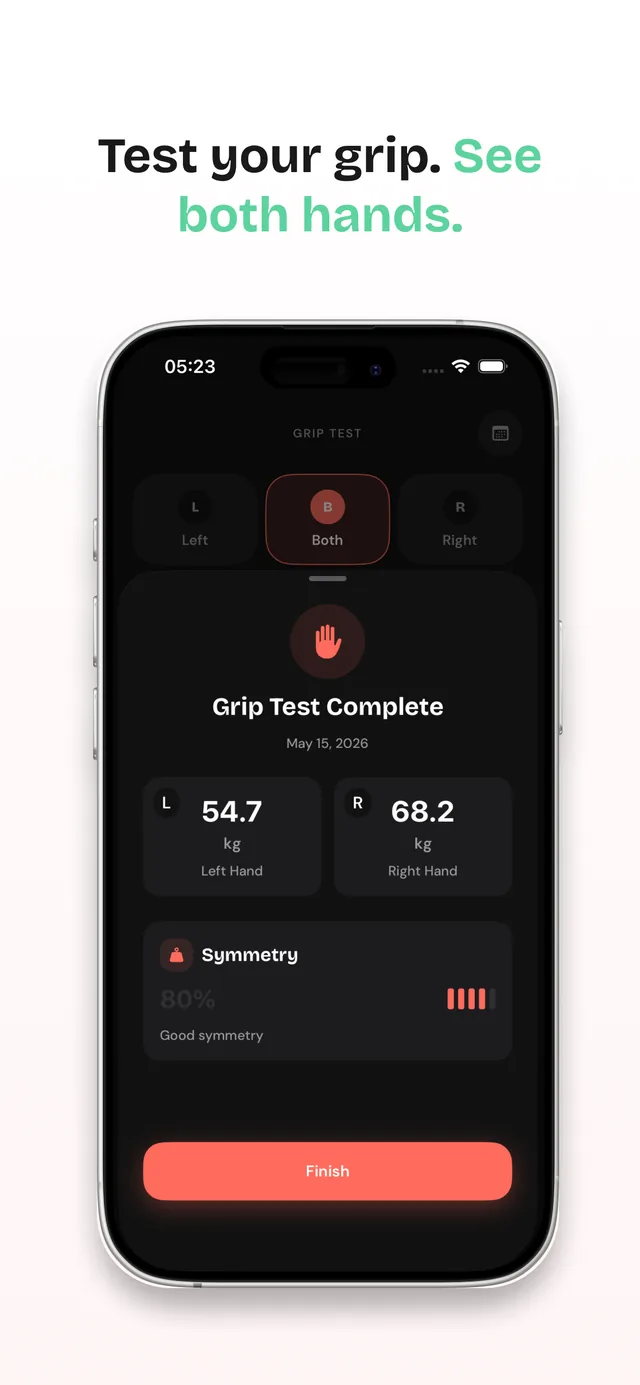
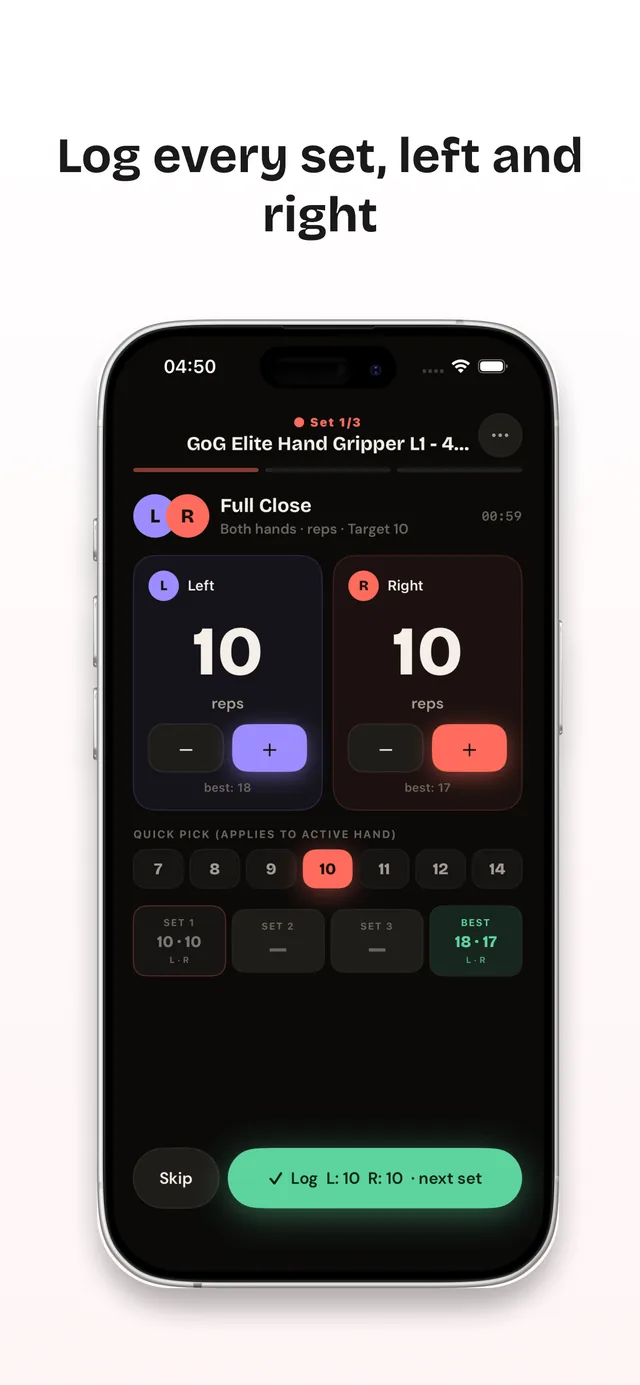
The free tier is genuinely usable, not a locked demo: unlimited workouts and custom exercises, up to 5 pieces of equipment, full per-hand tracking, dynamometer tests, weekly insights, a 30-day history window, and three routines. Pro ($4.99/month or $29.99/year) adds per-equipment and per-load PRs, 90-day insights with full history, unlimited routines, CSV export, and equipment photos. See the full free vs Pro breakdown.
Which grip tool is genuinely right for you
No trash-talk — each of these is the right pick for someone:
- Buy SQUEGG if you want a playful, gamified squeeze ball that measures and motivates in one object, and you don't already own a dynamometer. It leans casual and fun.
- Buy a DEXDIA / GripMeter setup if you're a clinic, physio, or coach who needs a certified-grade dynamometer with its own screen and multi-client profiles, and the ~$449 device is a professional tool, not a splurge.
- Buy Tindeq if you're a serious climber or coach who wants real-time force curves, max-hang protocols, and rate-of-force data. It's a premium instrument built for that job.
- Choose MrGripper if you want to start today, for free, with the gear you already have — and you want per-hand tracking, a symmetry score, and grip-specific PRs without being locked into one company's hardware.
Here's the part most comparisons miss: these aren't mutually exclusive. Already own a SQUEGG or a Tindeq? You can still enter those readings into MrGripper to keep every test, every gripper, and both hands in a single long-term history. The hardware measures; MrGripper remembers.
Track your grip — no gadget required
Grip Strength: MrGripper is free on the App Store — per-hand logging, a dynamometer grip test that works with any device, and PRs on iPhone, iPad, Mac, and Vision Pro.
FAQ
Can you track grip strength without a smart dynamometer?
Yes. If you want a force number, read it off any dynamometer you own and log it. If you don't have one, track reps, timed holds, and PRs instead — a full grip program needs consistent logging far more than it needs a specific gadget.
Does MrGripper connect to a Bluetooth dynamometer?
No. MrGripper doesn't pair with any device — you enter readings manually. That's the trade-off that lets it work with any dynamometer or gear you already own, instead of tying you to one brand's hardware.
Do you need a dynamometer at all to use MrGripper?
No. Plenty of people use it purely to program and log workouts — grippers, hangboards, dead hangs, pinch holds — and never enter a dynamometer reading. The dynamometer test is there when you want an objective number, not a requirement.
Is MrGripper really free?
Yes. It's free to download and the free tier includes full per-hand tracking, dynamometer tests, weekly insights, and a 30-day history. Pro ($4.99/month or $29.99/year) is optional and adds longer history, unlimited routines, per-equipment PRs, and CSV export.
What's the cheapest way to start tracking grip strength?
Install a free app and use the gear you own. A basic analog or digital hand dynamometer costs a fraction of any Bluetooth model, and MrGripper will log its readings per hand alongside the rest of your training.