 MrGripper
The short answer
Train grippers 2–3 days a week: 3–4 sets of 5–10 full closes per hand with a gripper you can shut cleanly, plus one lighter endurance day. Then add reps before you add resistance — the gap between consecutive rated grippers averages 20%, and never less than 13%. That single number explains most gripper plateaus.
A gripper ladder asks for jumps a barbell never would, and almost no routine you will find online accounts for that.
The routine
Two sessions a week, three if you're recovering well. Everything is logged per hand, because your hands are not the same and averaging them hides the problem.
| Day A — strength (2× per week) | Day B — endurance (1× per week, optional) | |
|---|---|---|
| Warm-up | 2 × 10 easy-gripper closes per hand | 1 × 10 easy-gripper closes per hand |
| Main work | 3–4 × 5–10 full closes per hand, working gripper | 2 × 15–20 closes per hand, easy gripper |
| Finisher | 2–3 negatives per hand with the goal gripper (once a week) | 3 × 20–30s closed holds per hand, easy gripper |
| Rest between sets | 1–2 minutes | 45–60 seconds |
A rep counts when the handles touch. If they don't, you trained everything except the range you bought the gripper for.
Leave at least one day between Day A sessions. That's not a recovery superstition — it's the one part of gripper training where the injury risk is real, and it's covered further down.
Why gripper progress stalls: the jumps are 13–33%
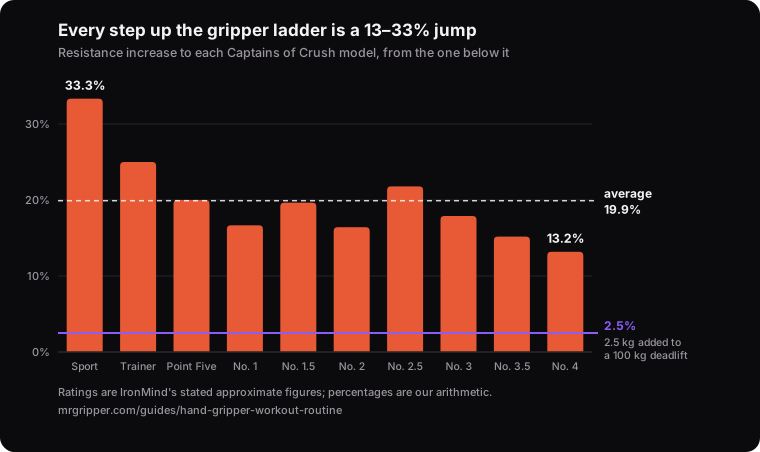
Here's the thing nobody puts in a gripper routine. Take IronMind's published resistance ratings for the Captains of Crush line and look at what each step actually asks of you.
| Step up | Resistance | Increase |
|---|---|---|
| Guide → Sport | 60 → 80 lb | +33.3% |
| Sport → Trainer | 80 → 100 lb | +25.0% |
| Trainer → Point Five | 100 → 120 lb | +20.0% |
| Point Five → No. 1 | 120 → 140 lb | +16.7% |
| No. 1 → No. 1.5 | 140 → 167.5 lb | +19.6% |
| No. 1.5 → No. 2 | 167.5 → 195 lb | +16.4% |
| No. 2 → No. 2.5 | 195 → 237.5 lb | +21.8% |
| No. 2.5 → No. 3 | 237.5 → 280 lb | +17.9% |
| No. 3 → No. 3.5 | 280 → 322.5 lb | +15.2% |
| No. 3.5 → No. 4 | 322.5 → 365 lb | +13.2% |
Ratings are IronMind's stated approximate figures for each model; the percentages are our arithmetic. Other brands use different ladders, but the pattern holds.
The average step is 19.9%. The smallest step in the entire range is 13.2%.
Now compare that to how you progress anything else. Adding 2.5 kg to a 100 kg deadlift is a 2.5% jump. A gripper asks for eight times that, minimum — and at the beginner end, thirteen times that.
So when someone closes the Trainer for 10 reps, buys the No. 1, and can't move it, nothing has gone wrong with their training. They just tried to add 40% to a lift in one session.
Every good gripper decision follows from this. You don't jump when you're ready to jump. You jump when you've built enough surplus on your current gripper to absorb a 20% cliff.
Step 1: pick three grippers, not one
One gripper gives you one intensity. You need three:
- Easy — you can close it 15+ times per hand. This is your warm-up and your endurance tool. Not optional; it's what lets you train volume without frying the tendons that end streaks.
- Working — you can close it cleanly 5–10 times per hand. This is where almost all your training happens.
- Goal — you can't close it, or you can close it once on a good day. This is for negatives and occasional attempts, never for volume.
Test it with your arm at your side and no shoulder heave. If you have to swing it into position or press it against your leg, the resistance is wrong for that slot.
The half-step models (Point Five, No. 1.5, No. 2.5) exist precisely because of the arithmetic above — IronMind's own catalogue labels each one “Bridge to the No. 1”, “Bridge to the No. 2”, and so on. If you're stuck between two whole numbers, that's not weakness. It's the ladder being too coarse, and the bridge gripper is the fix.
Step 2: progress inside a gripper before you jump
Because the next gripper is a 13–33% cliff, the only sane approach is to build a large surplus on your current one first. Three levers, used in this order:
- Add reps. Start at 3 × 5 per hand. Add a rep to one set per session until you're at 4 × 8, then 4 × 10. Only then consider moving up.
- Add time under tension. Once you own 4 × 10, hold each close shut for a beat before releasing. This is how the gripper group in Sharma's study trained — reps with a short isometric hold in the closed position — and it's a way to make a gripper harder without changing grippers.
- Bridge with the next gripper. Two ways in, once a week, done fresh:
- Negatives — close the goal gripper with both hands, then resist its opening with one hand for 3–5 seconds. 2–3 per hand.
- Overcrush holds — close it with help, then hold it shut single-handed for as long as you can.
When you can close the goal gripper for a single clean rep, it becomes your working gripper — and you drop back to 3 × 5. Yes, back to fives. That's what absorbing a 20% jump looks like.
How often should you train grippers?
Two to three sessions a week for the hard work, with at least a day between them.
The honest answer is that the direct evidence is thin and points slightly higher than most people train. The two gripper interventions on record used four sessions a week and three sessions a week, and both reported gains. So 2–3 isn't a ceiling imposed by physiology.
The reason to stay conservative is different, and Cameron Gill's evidence review of grip training names it precisely: grippers are unusually easy to overuse because they're convenient and cost you almost no systemic fatigue. You can do a set in a queue. Nothing tells you to stop. The forearm and hand tissues are the only thing limiting your volume, and they're the tissues that fail quietly.
Two practical rules:
- Ramp volume, don't launch into it. Tendons adapt to progressive loading, but a sudden spike in load they're unaccustomed to is where overuse injuries start. Start at two sets and add one set a week.
- When something aches, cut volume rather than stopping. In resistance training generally, one-third of prior training volume has been enough to retain strength adaptations. Two weeks at a third of your usual gripper volume costs you very little and resolves a lot.
Does the exact rep scheme matter?
Less than the internet implies. And the honest answer starts with how little direct evidence exists: a review of the grip-training literature turned up just two intervention studies that actually trained people with hand grippers. Both ran six weeks. Here's what they found.
- Berg and colleagues (2018) ran six weeks of maximal-strength work: four sets of four reps, four sessions a week, at roughly 90% of one-rep max, using a weight-loaded handgrip device. Handgrip 1RM rose from 49 kg to 62 kg — a 26.5% increase. Estimated forearm muscle mass barely moved (833 g to 856 g, not a significant change), which is worth noting: six weeks of heavy gripper work made these men much stronger without measurably bigger forearms. Early gripper gains are largely neural.
- Sharma and colleagues (2020) reportedly ran six weeks at the opposite end — 10 reps with a short isometric hold, three times a week, on a fixed 20 kg gripper — and reported a 26% rise in dynamometer grip strength, versus 10.6% in a squeeze-ball-only control group that wasn't statistically significant.
Two protocols with almost nothing in common. Nearly identical headline numbers.
The reasonable read is that over six weeks, doing progressive gripper work at all is the variable that matters. Heavy fours versus sets of ten is a rounding error next to consistency and progressive overload.
Which is liberating, and it's why this page spends more words on the 20% jump than on rep ranges. Your rep scheme is not your problem.
Now the caveats, because they're larger than the findings. Berg's study had seven participants — seven young men, in a cardiovascular physiology experiment about blood flow, using a pulley-loaded device rather than a rated torsion gripper. Sharma's paper isn't indexed in PubMed and we couldn't obtain the original; the figures above are as summarised in the review that cites it, and it tested the non-dominant hand only. Six weeks in beginners is also where percentage gains look their biggest.
So: the entire published case for hand-gripper training is one seven-man physiology study and one paper we couldn't read. That's not a reason to skip grippers — the mechanism is sound and the tool is proven in practice by an entire sport. It is a reason to distrust anyone who tells you their specific rep scheme is the optimal one. Nobody has the data to make that claim.
What grippers won't do for you
Grippers train crush grip — the closing force of your fingers against your palm. That's one grip type of three, and the transfer to the others is limited by design, because strength adaptations are largely specific to the grip you actually train.
Two consequences:
- Your deadlift won't necessarily improve. Support grip — holding a bar that gravity is pulling out of an open hand — is a different demand. Baseball studies by Szymanski and by Hughes added dedicated wrist and forearm training to normal lifting and found no greater crush-grip improvement than the control groups after 12 weeks, with neither group improving significantly at six. Grip work does not automatically become the grip strength you want.
- Pinch and hanging endurance go untrained. Grippers do nothing for thumb-opposed pinch strength or the support endurance of a long hang.
None of this makes grippers a bad tool. It makes them a specific tool. If your goal is a bigger deadlift, add heavy holds and hangs. If it's climbing or bar work, add dead hangs. For grappling, pair closing work with the fabric endurance in the BJJ grip-strength guide. If it's a bigger close, you're already in the right guide.
Why most people plateau
Ranked by how often each one is actually the cause:
- Jumping the ladder too early. Closing a gripper five times is not owning it. Five reps is where a gripper starts, and jumping from there into a 20% increase guarantees a wall.
- Counting half-closes. If the handles don't touch, the hardest part of the range never gets loaded. Your rep count goes up and your actual strength doesn't.
- Owning one gripper. With no easy gripper you can't train volume, and with no goal gripper you can't bridge. Every session becomes the same session.
- Maximum effort, every session. Testing your max is not training your max. Once every three or four weeks is plenty.
- Training to soreness and calling it progress. Elbow ache is not a training effect. See below.
- Not logging per hand. “I think I did eight last time” is how the weaker hand falls a full gripper behind without anyone noticing.
Already stalled? Drop one gripper level for two weeks of clean volume at 4 × 8–10 per hand, keep one weekly negatives session with the goal gripper, then retest. Most plateaus are accumulated fatigue plus an unlogged regression, not a genuine strength ceiling.
Elbow pain is what actually ends gripper streaks
Not a lack of motivation. Tendinopathy — a tendon repeatedly loaded past its tolerance without adequate recovery.
The relevant one for gripper training is at the medial epicondyle, the bony bump on the inside of your elbow, where several wrist-flexor tendons share a common origin. Clinically it's medial epicondylitis; you'll see it called golfer's elbow. The hallmark is pain and tenderness near the elbow that gets worse with gripping — the exact activity you're trying to progress.
The trap is that it starts mild and trainable. A minor ache after a hard session is common and often nothing. Pain that keeps showing up in the same spot and is consistently provoked by gripping is a different signal, and the worst response is pushing through unmodified, because a tendinopathy that becomes chronic can take months rather than weeks to settle.
If that's you: reduce gripper volume, drop the most provocative movements for a while, and see a physio or clinician rather than a training article. This page can tell you how to progress a gripper. It can't tell you what's happening in your elbow.
What's evidence-backed here, and what's gym practice
Most gripper routines present every instruction with identical confidence. Here's where each part of this one actually comes from.
| Part of the routine | Where it comes from |
|---|---|
| 2–3 sessions per week | Evidence-informed. The two gripper interventions on record used 3–4×/week; we recommend the lower end for overuse reasons. |
| 3–4 sets of 5–10 closes | Practice. A middle ground between the two studied protocols (4×4 heavy, and 10 reps with holds), neither of which is obviously superior. |
| Full closes only | Practice. The grip-sport convention. No study has compared partial to full closes. |
| Add reps before resistance | Reasoned. Follows directly from the 13–33% rating jumps plus standard double progression. Not tested on grippers. |
| Isometric hold at the close | Weakly supported. Part of Sharma's reported protocol — a paper we could not obtain. Treat as a sensible way to add difficulty, not a proven method. |
| Negatives with the goal gripper | Practice. Long-standing grip-community method; no gripper-specific trial supports it. |
| Deload to one-third volume | Evidence-informed by analogy. Bickel and colleagues found a third of prior volume retained adaptations in general resistance training, not grip specifically. |
| Log every set per hand | Practice + measurement logic. Your hands progress at different rates, and a merged number can't show it. |
Six weeks is roughly when the studied protocols produced measurable change, so give any version of this at least that long before judging it.
Running this routine in MrGripper
The routine above needs three things tracked that a general gym log won't give you: which gripper, which hand, and how the two compare over time.
- Add your three grippers to the gear library with their resistance ratings. The free tier holds up to 5 pieces of gear, so an easy/working/goal set fits with room to spare.
- Save Day A and Day B as routines. The free tier includes 3 routines — enough for both, plus a test day.
- Log every set per hand. Quick-pick rep values make a set a couple of taps, and left and right stay separate rather than being merged into one number.
- Run a dynamometer grip test every 3–4 weeks instead of maxing out on the gripper. Left, right, or both, with a left–right symmetry score — a cleaner progress check than a max attempt, and it doesn't cost you a training session. Our guide on grip strength symmetry covers how to read the gap.
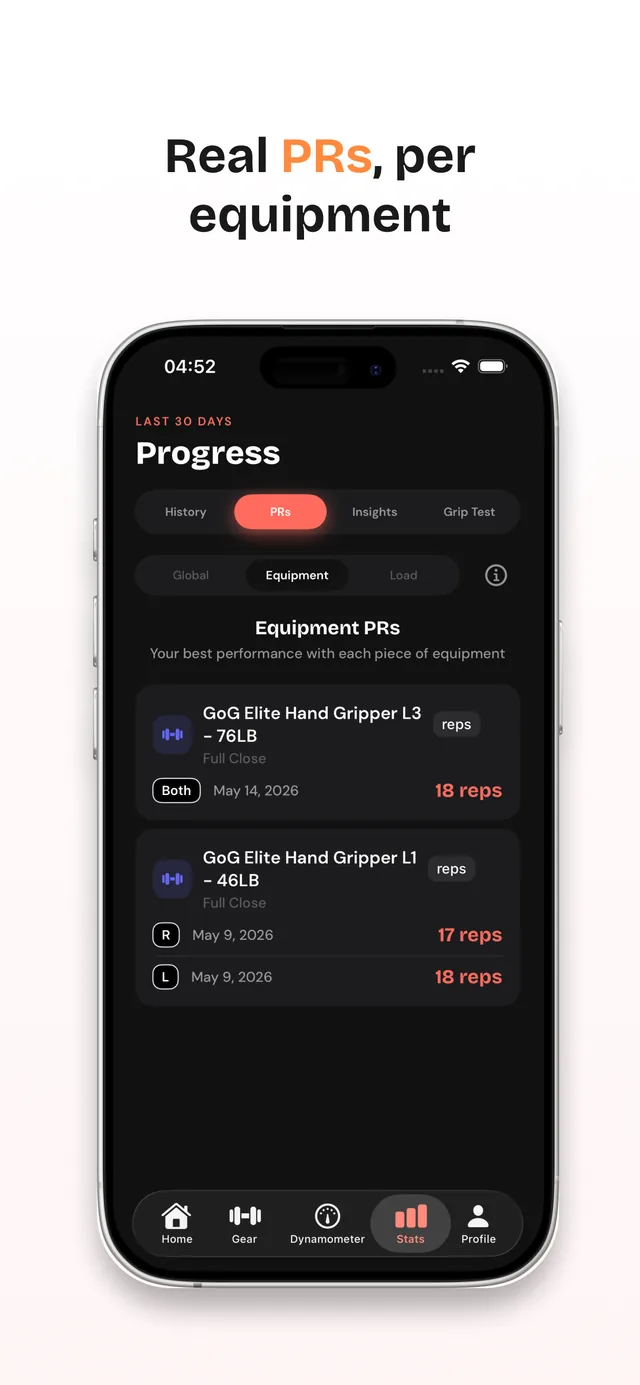
- Watch PRs per gripper. Personal records broken out per equipment and per load are a Pro feature ($4.99/month or $29.99/year) — that's what turns “am I ready to move up?” into a decision the data makes for you, rather than a guess.
The free tier runs this entire routine. Pro is what tells you when to jump.
Your grippers deserve a logbook
Grip Strength: MrGripper is free on the App Store — programs, per-hand logging, and a PR for every gripper you own.
FAQ
How many reps should I do with hand grippers?
For strength: 3–4 sets of 5–10 full closes per hand with a gripper you can shut cleanly. For endurance: 15–20 reps with an easier one. If you can't close a gripper 5 times, it's not a volume tool — use it for negatives and single attempts. The two gripper studies on record used 4 reps and 10 reps and reported nearly identical gains, so don't agonise over the exact number.
Do hand grippers actually work?
Yes, for crushing grip specifically. In the best-documented trial, six weeks of heavy gripper training raised handgrip 1RM by 26.5% — though in only seven participants. What grippers don't reliably do is improve other grip types — support grip for deadlifts and hangs, or pinch strength — because strength gains are largely specific to the grip you train.
Can I train with hand grippers every day?
You shouldn't need to, and the convenience that makes daily training tempting is exactly what makes grippers easy to overuse. Two or three focused sessions a week with a rest day between progresses better and is far less likely to leave you with elbow pain that stops training altogether.
How long before I see progress?
Both gripper interventions on record ran six weeks and reported roughly 26% improvements — in beginners, where gains come fastest. Give any routine at least six weeks of consistent, logged work before deciding it isn't working. Expect strength to move before size does: in Berg's study, six weeks of heavy gripper work produced a large strength gain with no measurable change in forearm muscle mass.
Why is my left hand a whole gripper behind my right?
A gap between hands is normal and usually smaller than it feels — pooled research puts the average dominant-hand advantage at about 8%. It only becomes a training problem if it widens, which you can't detect unless each hand is logged separately. Our grip strength symmetry guide covers what a normal gap looks like and when it matters.
Sources
- Gripper model resistance ratings and the “Bridge to the No. 1/2/3/4” labels — IronMind. Captains of Crush Grippers. Retrieved 1 August 2026. The percentage increases between models are our own arithmetic from IronMind's stated figures.
- Gripper overuse risk, grip specificity, tendinopathy and volume maintenance — Gill C. The Evidence-Based Guide to Grip Strength Training & Forearm Muscle Development. Stronger by Science. 26 February 2024. Retrieved 1 August 2026. Also the review through which the studies below were identified.
- Six-week heavy gripper training, +26.5% handgrip 1RM in seven men — Berg OK, et al. Maximal strength training-induced improvements in forearm work efficiency are associated with reduced blood flow. Am J Physiol Heart Circ Physiol. 2018;314(4):H853–62. Full text checked 1 August 2026: n = 7 men aged 24 ± 3; 4 sets × 4 reps at ~90% 1RM, 4 sessions/week; 1RM 49 ± 9 → 62 ± 10 kg; forearm muscle mass 833 ± 167 → 856 ± 181 g, not significant.
- Six-week moderate gripper protocol, reported +26% dynamometer grip — Sharma D, et al. Impact of Two Grip Strengthening Exercise Protocols on Grip Strength of Non-Dominant Hand. Indian J Public Health Res Dev. 2020;11:231. Not indexed in PubMed and not obtainable at the time of writing — the figures are as summarised in the review above, and are described on this page as reported rather than verified.
- Wrist and forearm training not producing greater crush-grip gains — Szymanski DJ, et al. Effect of 12 Weeks of Wrist and Forearm Training on High School Baseball Players. J Strength Cond Res. 2004;18:432. See also Hughes SS, et al. J Strength Cond Res. 2004;18:298.
- One-third of prior volume retaining strength adaptations — Bickel CS, et al. Exercise dosing to retain resistance training adaptations in young and older adults. Med Sci Sports Exerc. 2011;43:1177–87. General resistance training, not grip specifically.