 MrGripper
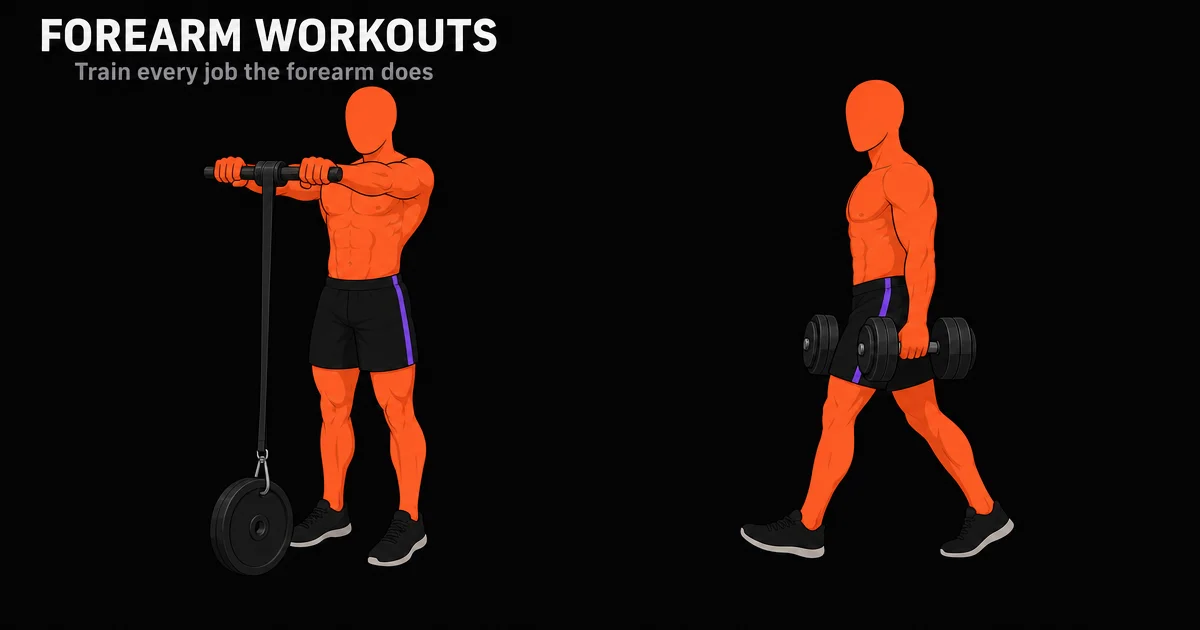
Forearm workouts: what a complete one trains
Your forearm is a crowd of muscles packed between the elbow and the wrist, split into teams that do different work. A forearm workout that only uses one of those teams leaves the others untrained, however hard you go.
It's easier to plan around the five jobs than around the muscle names:
- Wrist flexion: bending the palm toward the inside of the forearm. That's the flexor group on the palm side, the bulk you see when you turn your arm over.
- Wrist extension: lifting the back of the hand. That's the extensor group on the top of the forearm, the side you see when your palm faces down.
- Elbow flexion with a thumbs-up or palms-down grip: the brachioradialis, the thick muscle running from the outside of the elbow toward the thumb. It's what makes a forearm look wide from the side.
- Rotation and side-to-side tilt: turning the palm up (supination) and down (pronation), and tilting the hand toward the thumb or little finger (radial and ulnar deviation).
- Grip: closing the fingers and thumb and holding on. Crush, support, and pinch all lean on the finger flexors, which sit in the forearm and pull on the fingers through long tendons.
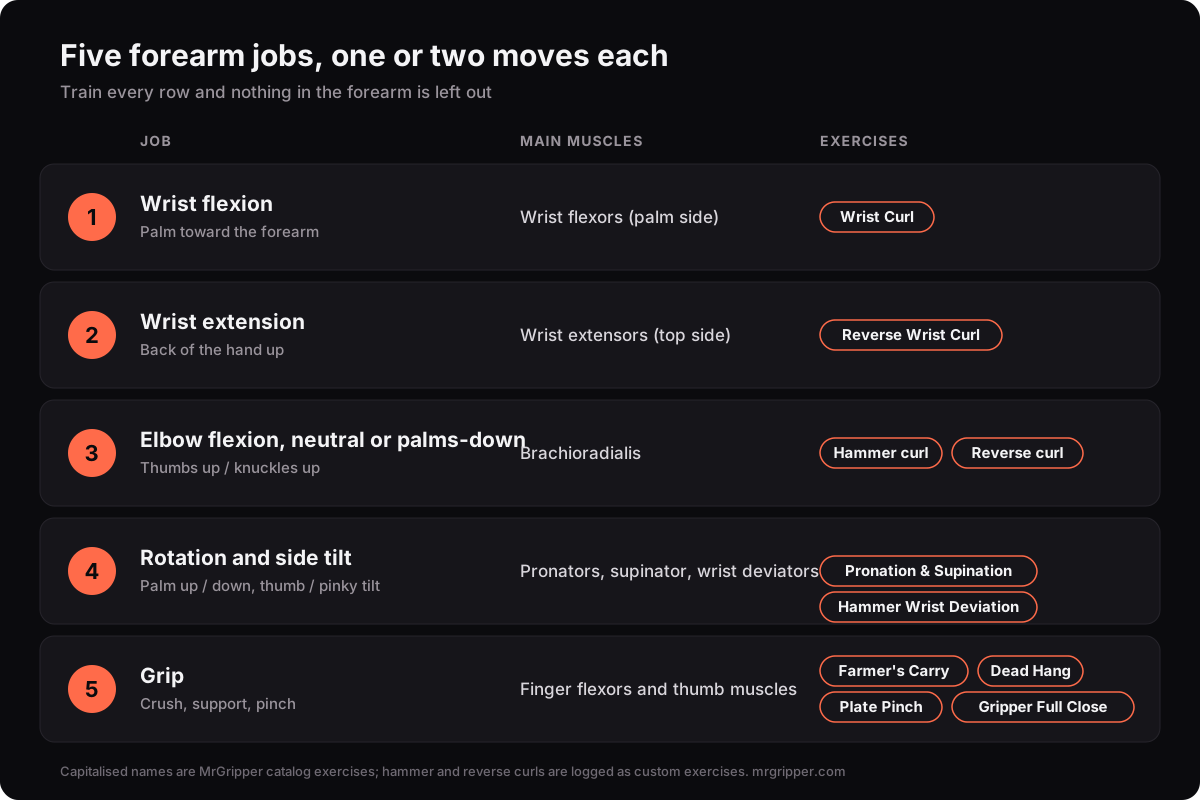
Many exercise lists lean on the first job and skip others. Wrist curls and grippers both load the palm side, so a routine built from them feels thorough and still never trains the extensors or rotation. Those are the gaps a structured plan closes, and they cost very little time to fill.
Key takeaways
- Train all five jobs: flexion, extension, the brachioradialis, rotation, and grip. One or two moves per job is enough.
- No single exercise covers the forearm. That's why "the best forearm exercise" has no honest one-word answer.
- For size, weekly hard sets matter more than the load. The ACSM ties bigger gains to 10 or more sets a week.
- Train forearms at least twice a week, after your pulling work, not before it.
- Log each hand on its own: reps and loads show whether each job is progressing, and a grip test at the start and end of a block shows whether your grip moved.
What is the most effective forearm exercise for each job?
There isn't a single most effective forearm exercise, because no one movement covers all five jobs. A wrist curl does nothing for rotation, and a farmer's carry never bends the wrist at all. The useful question is which move does each job well, with the least setup. Here's one pick per job, with one cue and one fault to watch. Start each move light enough for slow, full-range reps, and end most sets about 2–3 reps short of failure, the effort target in the ACSM guidance covered below.
Wrist flexors: Wrist Curl
Sit with your forearm on a bench or your thigh, palm up, hand hanging past the edge. Let the weight roll down toward your fingertips, then curl your fist up as far as the wrist goes.
- Cue: the forearm stays glued to the bench. Only the wrist moves.
- Fault: lifting the elbow or forearm to help, or cutting the range short to move more weight.
Dumbbells, a barbell, or a kettlebell all work. Behind-the-back and cable versions load the same muscles from a different angle.
Wrist extensors: Reverse Wrist Curl
Same setup, palm down. Let the knuckles drop toward the floor, then lift the back of the hand as high as it goes.
- Cue: hold the weight loosely, so the fingers don't take over.
- Fault: using your wrist-curl weight. The extensors are the smaller group, and they need a much lighter load to move through a full range.
This is the move routines often leave out. If you only add one exercise after reading this, add this one.
Brachioradialis: hammer curl and reverse curl
Both are elbow curls. The grip is what changes the work. A hammer curl uses a thumbs-up, neutral grip, a position where the brachioradialis has good leverage, so you can handle real weight. A reverse curl uses a palms-down grip, which puts the biceps at a disadvantage and makes the brachioradialis and wrist extensors do more of the job, so the load drops.
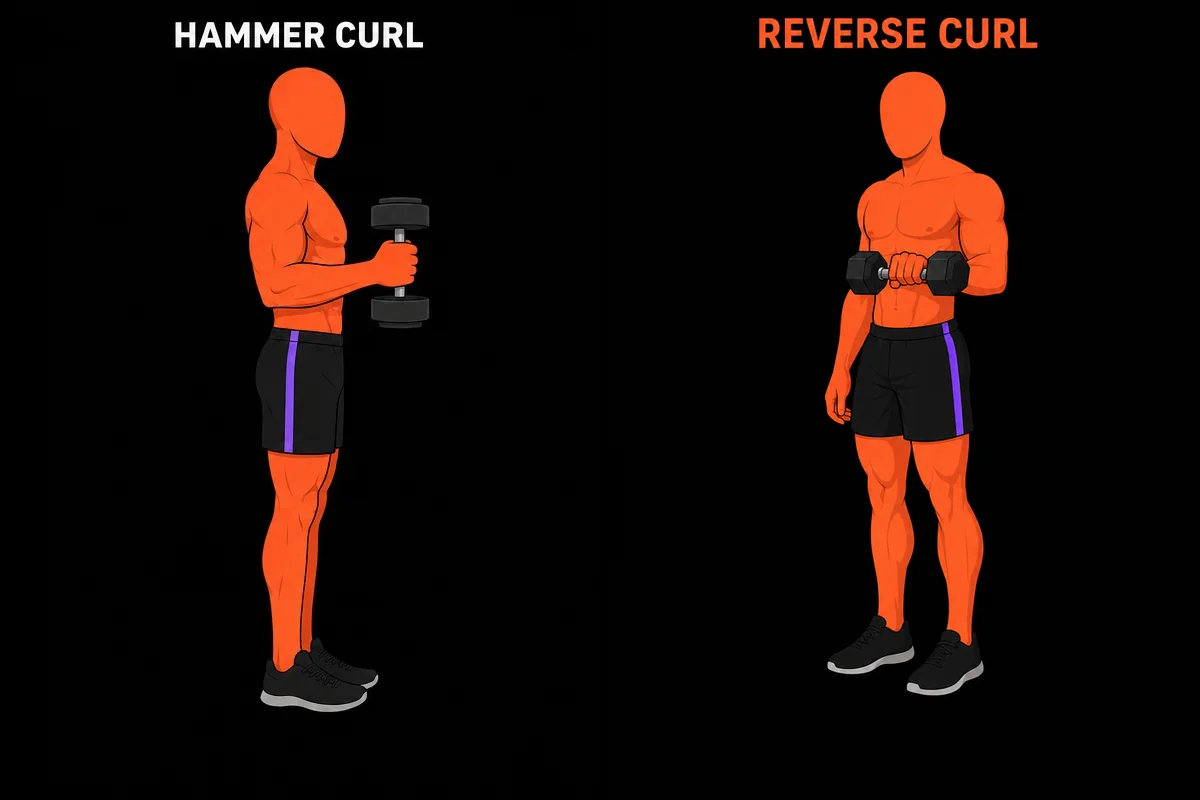
- Cue: elbows pinned to your sides, wrists straight.
- Fault: swinging the torso to start the rep. On reverse curls, letting the wrists bend back under the load.
Zottman curls combine the two: up with palms up, rotate at the top, lower palms down.
Rotation and side-to-side: Pronation & Supination, Hammer Wrist Deviation
Rotation is the job most people skip. For Pronation & Supination, rest your forearm on your thigh with a hammer or a one-ended dumbbell held thumbs up. Slowly rotate until the palm faces up, come back to vertical, then rotate the other way. For Hammer Wrist Deviation, stand with the hammer at your side, thumb forward, and tilt the head up toward the thumb, then down toward the little finger.
- Cue: grip closer to the head of the hammer to make it easier and toward the end to make it harder. Adjust the lever before you add weight.
- Fault: letting the elbow swing to fake the range, or going heavy too soon. These are small muscles, and they need control more than load.
Grip: Farmer's Carry, Dead Hang, Plate Pinch, and grippers
Grip comes in three types, and each needs its own exercise:
- Support grip holds on to something that gravity is pulling out of your hand. Use Farmer's Carry and Dead Hang (more in the guide to dead hangs).
- Crush grip closes the hand against resistance. Use a hand gripper for Gripper Full Close.
- Pinch grip squeezes between thumb and fingers. Use Plate Pinch: two smooth plates pressed together, lifted from the side.
- Cue: on carries, stand tall and walk without the weights swinging.
- Fault: straps or re-gripping mid-set. If the hand opens, the set's over.
If grip is your main goal rather than the whole forearm, how to improve grip strength goes deeper on all three types, and the hand gripper workout routine covers crush work on its own.
How to get bigger forearms
To get bigger forearms, give each forearm job enough hard sets every week, take those sets close to failure, and add load or reps over time. The research on general muscle growth says weekly volume and effort matter, and the weight on the bar matters less than you'd think. Expect it to be slow, and don't trust anyone who puts a number of centimetres on it.
The evidence here comes from the American College of Sports Medicine's 2026 position stand on resistance training (Currier et al., 2026). It pools reviews of training in healthy adults in general. It isn't a forearm study, and forearm-specific growth research is thin. Treat what follows as general muscle-growth rules applied to a small muscle group, not as forearm-proven fact.
Count weekly hard sets
In the ACSM review, muscle growth was greater with higher weekly volumes, defined as 10 or more sets a week. The ACSM figure is per muscle group; treating each forearm job as its own group is our working assumption. So count hard sets for each job separately: 10 sets of wrist curls is a lot of flexor work and zero extensor work. Grip work also loads the forearm's finger flexors, so a heavy grip day adds to palm-side fatigue. Count it as its own job, and if your grip work is heavy, keep wrist-curl volume lighter that session.
A practical way in: start with two sets of each move, twice a week, and add sets to the job that lags.
Light loads work if sets end close to failure
The same review found that growth didn't differ across loads from 30% to 100% of a one-rep max. Sets didn't have to go all the way to failure either. Ending sets near failure, with a target of 2–3 reps in reserve, was enough, though the authors note the evidence can't pin down an exact target.
This suits forearms well. Wrist curls with a heavy dumbbell tend to turn into elbow swings, and higher-rep sets with a weight you control keep the work on the wrist. What counts is effort: the last few reps should be genuinely hard.
Why forearms feel hard to grow
Many lifters say forearms are a hard muscle to grow, and part of that is real. How much muscle you can add, and where a muscle sits along the bone, varies between people. Some forearms carry their bulk close to the elbow and look slim at the wrist no matter what. There's little forearm-specific data on how much that matters, so you can't measure your way around it.
The rest is usually programming. Forearms tend to get a few sets at the end of a session, picked at random and rarely progressed. Those sets rarely add up to 10 hard sets a week for any single job. Strength and size also don't move together: in a small, uncontrolled study of young men doing heavy handgrip training, grip strength rose a lot while estimated forearm muscle mass didn't change significantly (Berg et al., 2018). A better grip doesn't always mean a bigger forearm, and it isn't evidence that the forearm work failed.
Toning: muscle plus body fat
"Toned" forearms are two things: some muscle, and little enough fat over it that the shape shows. The training above handles the muscle. If you want more definition, that comes from lowering overall body fat. Endless high-rep wrist work won't burn fat off one spot.
How often should you train forearms, and how many sets?
Train forearms at least twice a week, with at least two sets per exercise. Those are the ACSM's baseline recommendations for resistance training in healthy adults. The same review found that frequency didn't change growth once total weekly volume was matched, so two sessions is a scheduling choice rather than a magic number. If 10 sets for a job feels like too much in one go, split it across two or three days.
Put forearm work after pulling and deadlifts. A grip that's already tired from wrist curls makes your rows, pull-ups, and deadlifts end early, and then you lose both. Finish the big lifts first, then train forearms. A mini-session for each setting follows below.
Forearm workouts by setting: gym, dumbbells, cables, and home
Pick the setting you actually train in. Each mini-session covers flexors, extensors, and one of the remaining jobs. Each session, swap the third move to the next job, so rotation, the brachioradialis, and grip take turns.
| Setting | Move 1 | Move 2 | Move 3 |
|---|---|---|---|
| Gym (barbell) | Wrist Curl (barbell) | Reverse Wrist Curl (barbell) | Farmer's Carry |
| Dumbbells only | Wrist Curl | Reverse Wrist Curl | Hammer curl |
| Cable station | Cable wrist curl | Cable reverse wrist curl | Rope hammer curl |
| Home, no weights | Band Wrist Curl (palm forward) | Band Wrist Curl (palm back) | Towel wring or Rice Dig |
No weights at home still gives you plenty of options:
- Towel: wring a rolled towel hard in both directions for rotation and grip, or hang a towel over a bar for a Towel Hang.
- Rice bucket: plunge the fingers in, spread them open against the rice, grab, twist, and release. It works the finger extensors that grippers ignore.
- Water jugs: a full jug works for wrist curls, reverse wrist curls, and short carries.
- Resistance band: stand on one end, arm at your side, and curl the wrist up against it, palm forward or palm back.
How to progress forearm training and check it worked
Progress forearm training with double progression. Pick a rep range for each move. Add reps from session to session until every set reaches the top of the range, then add the smallest load jump you can and drop back to the bottom of the range. Forearm muscles are small, so small jumps matter: for wrist work, the step between dumbbell sizes can be a big share of the load. Fractional plates, a lighter dumbbell, or a slower tempo all count as progress.
Two habits give you real numbers, not guesswork:
- Log left and right separately. Your reps and loads per move show whether each job is progressing. Dumbbell and grip work hide gaps when both hands go into one number. Say your right hand finishes every set and your left stalls a couple of reps early. A merged log averages the two, and the gap disappears.
- Test grip at the start and end of each block. A grip test measures your grip, not your extensors, rotation, or size, so read it alongside your log. Use a hand dynamometer, or the protocol in test your grip strength at home, under the same conditions each time. Compare each hand with its own earlier reading, then look at the left–right gap.
Some difference between hands is normal. Grip strength symmetry covers how big a typical gap is and when a change is worth noticing. What you want from a block is both hands moving up, and the gap staying put or closing.
Tracking a forearm block in MrGripper
MrGripper logs each of these moves per hand. Wrist Curl, Reverse Wrist Curl, Pronation & Supination, Hammer Wrist Deviation, Wrist Roller, Farmer's Carry, Dead Hang, and Plate Pinch are already in the exercise catalog. Hammer, reverse, and Zottman curls go in as custom exercises, which are unlimited on the free tier.
For the before-and-after check, run a dynamometer grip test for the left hand, the right hand, or both. You type in the reading from whatever dynamometer you own; the app doesn't connect to the device. It then shows each hand and a left–right symmetry score.
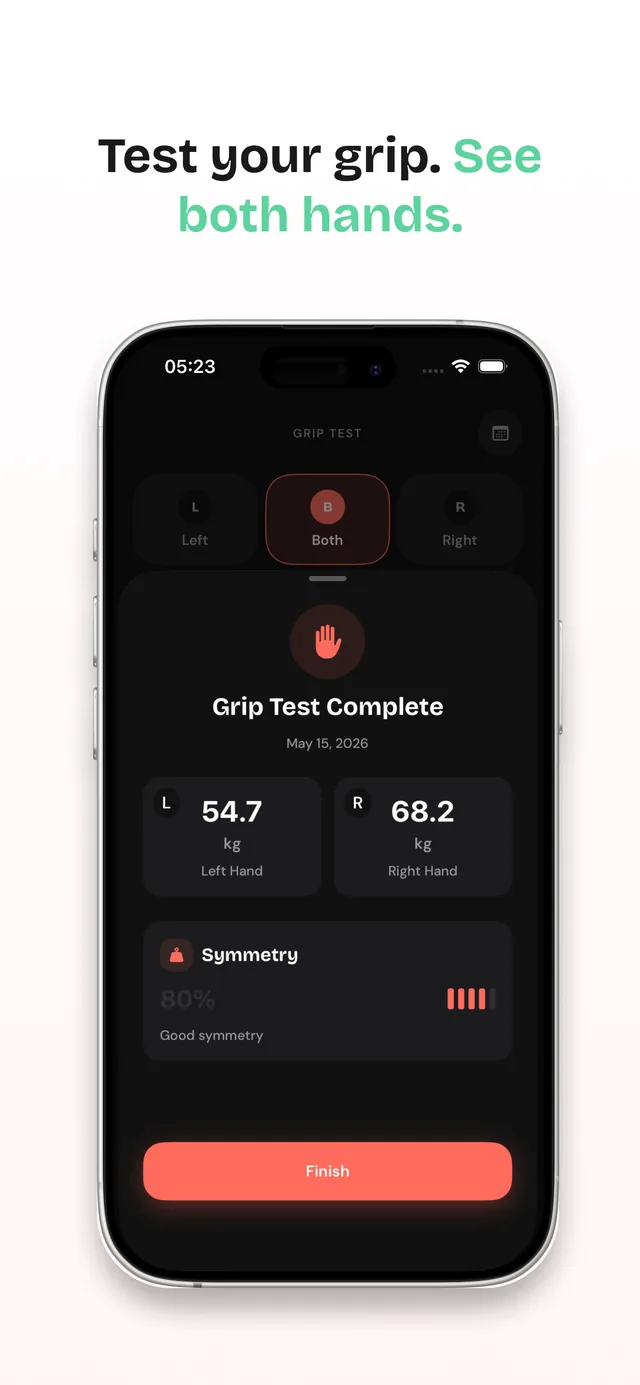
The free tier includes per-hand tracking, dynamometer tests, the symmetry score, PRs per exercise and hand, and a 30-day history window. MrGripper Pro adds per-equipment and per-load PRs, so a dumbbell wrist-curl PR stays separate from a barbell one. It also shows your full history; the free tier shows the last 30 days, which matters if a block runs longer than a month.
Can forearm workouts help with wrist pain?
Not as a self-prescribed fix. If your wrist already hurts, a new forearm program isn't the place to start.
For mild wrist pain, the NHS advises keeping the hand and wrist moving with gentle exercises, and not lifting heavy objects or gripping anything too tightly while it hurts (NHS). It says to see a GP if the pain stops you doing normal activities, hasn't improved after 2 weeks of home treatment, keeps getting worse or coming back, or comes with tingling or loss of feeling in the hand or wrist.
Exercise therapy for hand and wrist tendon problems has limited evidence behind it. A 2023 systematic review found the research on exercise for hand and wrist tendinopathy too limited to say what works or at what dose (Cordella et al., 2023). If you're dealing with a sore wrist or elbow, work with a physio who can examine it, rather than adding sets and hoping.
In a healthy wrist, normal forearm fatigue during a hard set is expected. Sharp pain, numbness, or tingling isn't. Stop the exercise. Numbness or tingling is a reason to see a GP, and so is sharp pain that doesn't settle.
Track every forearm job, per hand
Grip Strength: MrGripper is free on the App Store. Log each forearm move per hand, run a grip test from any dynamometer at the start and end of a block, and watch the left–right symmetry score.
Forearm workout FAQ
How do forearms get bigger?
Forearms grow the way other muscles do: enough hard sets each week, taken close to failure, with reps or load added over time. The ACSM links bigger gains to 10 or more weekly sets. Spread those sets across the flexors, extensors, brachioradialis, and grip, and don't expect a fixed size gain or timeline.
What is the most effective forearm exercise?
No single exercise is most effective, because none covers all five forearm jobs. A good forearm routine uses a set of moves: Wrist Curl for the flexors, Reverse Wrist Curl for the extensors, a hammer or reverse curl, Pronation & Supination for rotation, and a grip move such as Farmer's Carry.
Are forearms a hard muscle to grow?
They can feel that way. Genetics and where the muscle sits along the bone vary between people, and forearm-specific research is thin. More often, forearms get a few random sets at the end of a session and rarely add up to 10 hard sets a week for any one job. Fix the programming before blaming genetics.
How can I tone my forearms?
Toned forearms are some muscle plus low enough body fat for the shape to show. Train all five forearm jobs with hard sets at least twice a week to add the muscle. Definition comes from lowering overall body fat. High-rep wrist work won't burn fat off your forearms specifically.
Do forearm workouts really work?
Yes, for what they train. Resistance training builds strength and muscle in healthy adults, and strong forearms support the grip you use to carry, open, and hold things. Harvard Health notes there's no evidence yet that building forearm muscle or grip improves longevity. Log each hand and test your grip before and after a block to see your own result.
Can forearm workouts help with wrist pain?
Don't use them as a self-prescribed fix. For mild wrist pain, the NHS suggests gentle movement and avoiding heavy lifting and tight gripping. See a GP if pain stops normal activities, hasn't improved after 2 weeks, or comes with tingling or numbness. Evidence for exercise therapy in wrist tendinopathy is limited, so work with a physio.
Sources
- Weekly volume, load range, effort, frequency, and sets per exercise: Currier BS, et al. American College of Sports Medicine Position Stand. Resistance Training Prescription for Muscle Function, Hypertrophy, and Physical Performance in Healthy Adults: An Overview of Reviews. Med Sci Sports Exerc. 2026;58(4):851–872. General resistance-training evidence, not forearm-specific.
- Grip strength rising without a significant change in estimated forearm muscle mass: Berg OK, et al. Maximal strength training-induced improvements in forearm work efficiency are associated with reduced blood flow. Am J Physiol Heart Circ Physiol. 2018;314(4):H853–H862.
- Forearms and everyday grip, and no current evidence for longevity: Klein S. Forearm workouts: Strengthening grip for everyday function. Harvard Health Publishing. 22 November 2024.
- Wrist pain self-care and when to see a GP: Wrist pain. NHS.
- Exercise therapy for hand and wrist tendinopathy: Cordella M, et al. Evidence for exercise therapy in patients with hand and wrist tendinopathy is limited: A systematic review. J Hand Ther. 2023;36(4):940–955.