 MrGripper
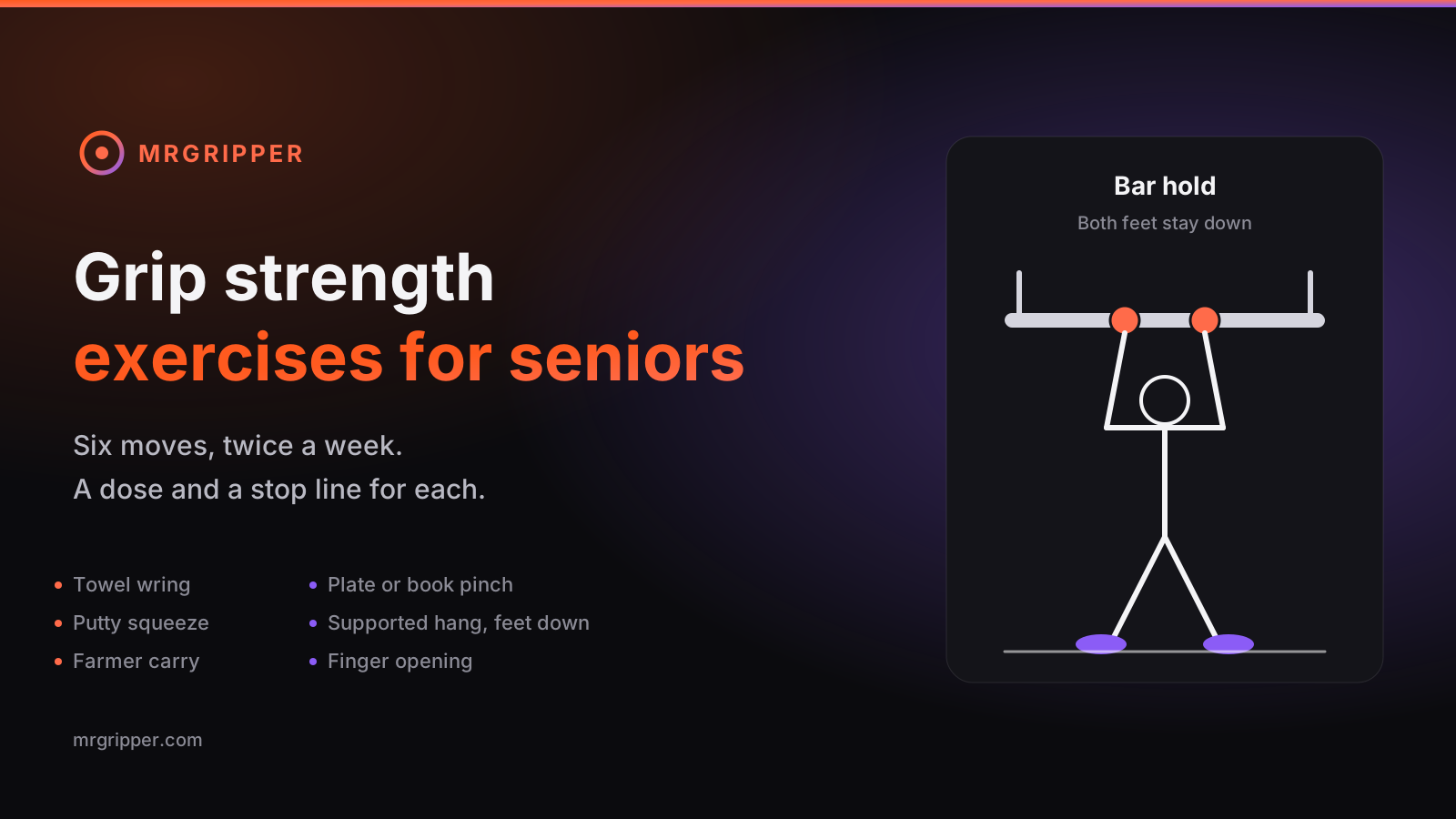
Grip exercises for this week
| Exercise | Dose | Stop if |
|---|---|---|
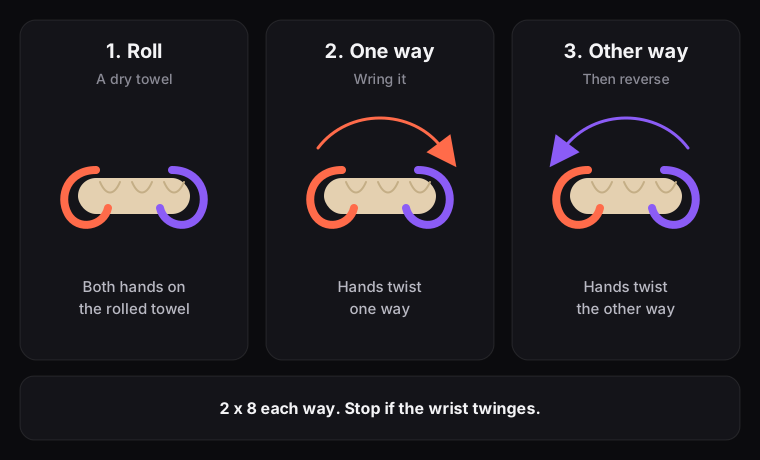
| Towel wring | 2×8 each way | Wrist twinges |
| Putty squeeze | 2×8 slow closes | Knuckle pinches |
| Farmer carry | 2×20-second walks | Shoulder hikes, or fingers open |
| Plate or book pinch | 2×10–15 second holds | Thumb joint aches |
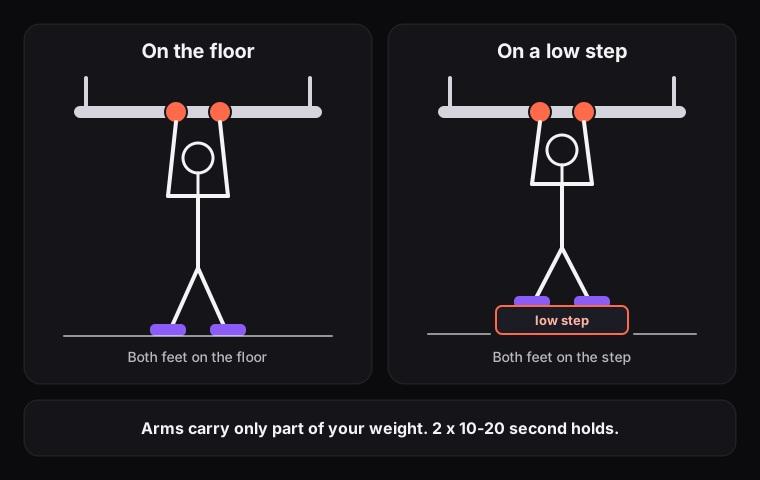
| Supported hang, feet down | 2×10–20 second holds | Shoulder or elbow feels sharp |
| Finger opening | 2×8 opens | Back of the hand cramps |
Talk to your doctor or physio if you have arthritis, recent surgery or pain. Do the six moves on two days, with a rest day between them. On a day you also do the full-body work further down, do this list after those movements.
Roll a dry towel and wring it one way, then the other. For the squeeze, use soft putty or a soft ball, and close each hand slowly. The farmer carry is a light bag or dumbbell in each hand, walking tall. Pinch a smooth plate or a thick book between the thumb and the fingers of one hand, then the other. Open each hand against a light elastic band around the fingertips.
For the bar hold, keep both feet on the floor or on a low step so the arms carry only part of your weight. That is the dead-hang alternative on this plan. If you already hang with your feet off the floor, the dead hang guide covers how to time those hangs.
Enter each hand's dynamometer reading in MrGripper, free.
Download freeFull-body context
These six moves are the hand work for the week. The same two or three days also need a stand, a hinge, a push, a pull, and a carry. The CDC's older-adult activity page asks for muscle-strengthening on at least two days a week, plus aerobic activity and balance practice.
Pick the task that currently fails: standing from a chair, carrying groceries, or opening a jar. That task decides which row matters most. Test it first with body weight or a light object. In week one, leave about three repetitions unused on most sets.
| Category | Starting exercise | Grip demand | Adjustment |
|---|---|---|---|
| Squat or stand | Chair stand | Low, unless you hold a weight | A higher seat, or hands on the chair, if balance wobbles |
| Hinge | Hip hinge to a raised surface | Optional light hold | A shorter range if the back position wanders |
| Push | Wall or countertop push-up | Open hand on the surface | A higher surface if the wrists ache |
| Pull | Band row or machine row | A moderate close on the handle | A thicker handle if the hand tires before the back |
| Carry or hold | Suitcase carry | High, and specific to carrying | Less load, or a shorter walk, if posture leans |
Starting dose: one or two sets of 6–12 smooth repetitions for the first four categories, then one or two short carries. Add a repetition only while the last one still looks like the first. Do the grip list after these larger movements.
A check you can run mid-set
- Steady breathing, even tempo, balance holds: keep the dose.
- Uncertain balance, or a grip that opens early: shorten the range, the load, or the time.
- Sharp pain, numbness, or a joint that feels unstable: stop for the day.
Progress one variable at a time
- Add one or two repetitions before you add load.
- Add a few seconds, or a few steps, before a carry gets heavier.
- Let the weaker hand set the time. Match the other hand to it, and write the gap down.
- When the week feels heavy, repeat the same doses.
An example week: chair stands, a countertop push-up, a band row, and two 15-second suitcase carries, plus the grip list. The next week, if the hands feel the same the morning after, add five seconds to the carries and leave the weight alone.
Once a week, look at three questions. Did the chair stand or the carry get easier while the hands felt the same the next morning? Did the weaker hand hold its time? Did the hands quit during the rows or the carries?
Time the bar hold with the built-in timer, free. You start it and you stop it.
Download freeHow to know it's working
Every 2–4 weeks, retest with the same dynamometer, once per hand. Use the same chair, the same handle, and the same number of tries as last time. Write both numbers down the same day. You type those readings in. MrGripper stores each hand on its own, and the timer is one you start and stop for holds and hangs.
Free includes 7- and 30-day trends and 30 days of history. Pro adds longer windows and CSV export.
Age norms for a reading live on the grip strength calculator pages. One retest can move because the setup or the effort changed. Change the doses only after two retests point the same way. Copy the setup from the home grip test guide.
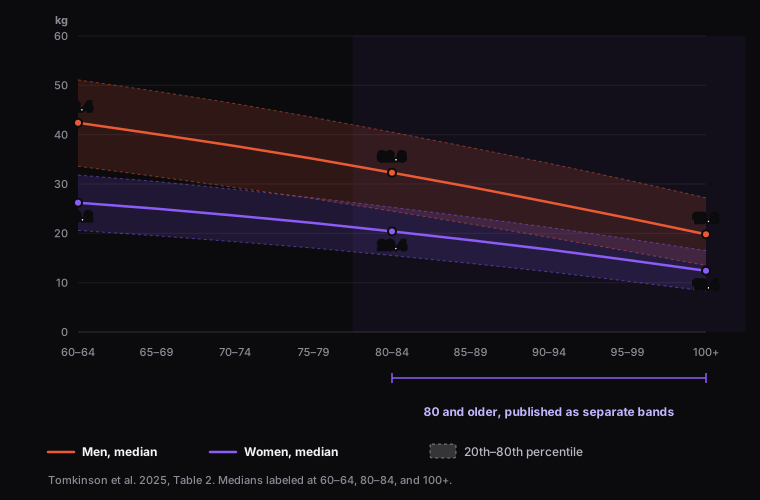
| Age | Men | Women | ||||
|---|---|---|---|---|---|---|
| P20 | P50 | P80 | P20 | P50 | P80 | |
| 60–64 | 33.6 | 42.4 | 51.1 | 20.6 | 26.2 | 31.8 |
| 65–69 | 31.5 | 40.1 | 48.8 | 19.5 | 25.0 | 30.5 |
| 70–74 | 29.3 | 37.7 | 46.3 | 18.3 | 23.6 | 28.9 |
| 75–79 | 27.0 | 35.1 | 43.5 | 17.0 | 22.1 | 27.2 |
| 80–84 | 24.5 | 32.3 | 40.5 | 15.5 | 20.4 | 25.3 |
| 85–89 | 21.9 | 29.4 | 37.4 | 13.9 | 18.6 | 23.3 |
| 90–94 | 19.2 | 26.3 | 34.2 | 12.2 | 16.7 | 21.2 |
| 95–99 | 16.4 | 23.1 | 30.8 | 10.3 | 14.6 | 18.9 |
| 100+ | 13.5 | 19.8 | 27.2 | 8.3 | 12.4 | 16.5 |

Log both hands, then retest in two weeks
Enter the dynamometer reading for each hand. The timer covers the holds.